
Have you ever had a kidney stone? Then you already know how much it hurts. Maybe you just found out you have one. Maybe you’re scared of getting another one. Either way, you are not alone. You’ve probably already searched online. One site says to avoid oxalate. Another says to eat more calcium. A third says to cut out dairy completely.
That’s a lot of mixed advice. It’s confusing, especially when you’re in pain or scared of more pain.
In July 2026, the American Urological Association updated its kidney stone guideline. It backs up what renal dietitians already knew: a whole-food diet beats a long list of “don’t eat this” foods. This article breaks it all down in plain language. You’ll learn exactly what steps to take, backed by real research.
This article contains affiliate links. We earn a small commission if you buy through them, at no extra cost to you. We only recommend products and programs we truly believe in.
Table of Contents
Types of Kidney Stones
Your kidneys filter waste out of your blood. Sometimes that waste builds up faster than your body can flush it out.
The extra minerals clump together. That clump becomes a stone.
Doctors also call kidney stones renal calculi, nephrolithiasis, or urolithiasis.
You need to know your stone type before you can prevent more stones. Each type needs its own plan.
Calcium Oxalate and Calcium Phosphate Stones
These are the most common stones by far. Calcium oxalate makes up about 70% of all kidney stones.[1]
Calcium phosphate makes up another 10%.[1]
Oxalate occurs naturally in many plant foods. It binds to calcium in your urine and forms a stone.
Here are the biggest risk factors for calcium stones:
- Not drinking enough water
- Eating too much animal protein, salt, or added sugar
- Not eating enough calcium
- Taking too much vitamin D
- Having diabetes, metabolic syndrome, gout, and/or hyperuricemia
- Having a digestive disease like Crohn’s or ulcerative colitis
Uric Acid Stones
Uric acid stones make up 5% to 10% of all stones. A diet high in meat and animal protein raises your risk.
People with type 2 diabetes also face a higher risk.[2] The average American diet runs high in animal protein, so this makes sense.
Struvite Stones
Struvite stones make up about 10% of cases. A urinary tract infection (UTI) causes them.
Bacteria from the infection release ammonia. That ammonia builds up in your urine and forms a stone.
Diet alone won’t stop this type. You need to treat the infection too.
Cystine Stones
Cystine stones are rare. They make up less than 1% of all kidney stones.
A genetic condition called cystinuria causes them. It floods your urine with too much cystine, an amino acid.
Since it’s genetic, your family members carry a higher risk too.
How to Find Out Your Kidney Stone Type
You need lab testing to know your stone type for sure. Catch any stone you pass in a strainer.
Then bring it to your urologist. They’ll send it to a lab for testing.
Your doctor will also run bloodwork and a 24-hour urine test. These tests build a full picture of your risk factors.
Skip this step, and you’re just guessing. Guessing leads to frustration and wasted effort.
Once you know your type, the rest of this article makes a lot more sense.
Kidney Stone Symptoms
A small stone might not cause any symptoms. But once it moves, you’ll feel it.
Watch for these signs:
- Sharp pain in your side or back
- Pain in your lower belly or groin
- Pink, red, or brown urine
- Cloudy or bad-smelling urine
- Burning when you pee
- Feeling like you always need to pee
- Nausea or vomiting
- Fever or chills
The pain often comes in waves. It can also move to a new spot as the stone travels.
Call your doctor if any of these symptoms show up. Seek help right away if you have a fever, since that can mean infection.
Tips to Prevent Kidney Stones Naturally
1. Ask for a 24-Hour Urine Test
This should be the very first step. It’s the test that turns generic advice into a plan built for your body, yet most people never get one.
A 24-hour urine collection measures your calcium, oxalate, citrate, sodium, uric acid, and total urine volume over a full day. Those numbers show your care team exactly what’s driving your stones.
Guidelines call for this test in anyone who forms recurring stones, or even a first stone with risk factors for more.[3] But it rarely happens in real life.
One study tracked over 28,000 people at high risk for another stone. Only 7.4% got a 24-hour urine test within 6 months of their diagnosis.[4]
Don’t wait for your doctor to bring it up. Ask directly: “Can I get a 24-hour urine test to find out what’s causing my stones?”
If your doctor says no, ask why. You can also ask for a referral to a urologist or nephrologist who orders this test routinely.
2. Drink Enough Water
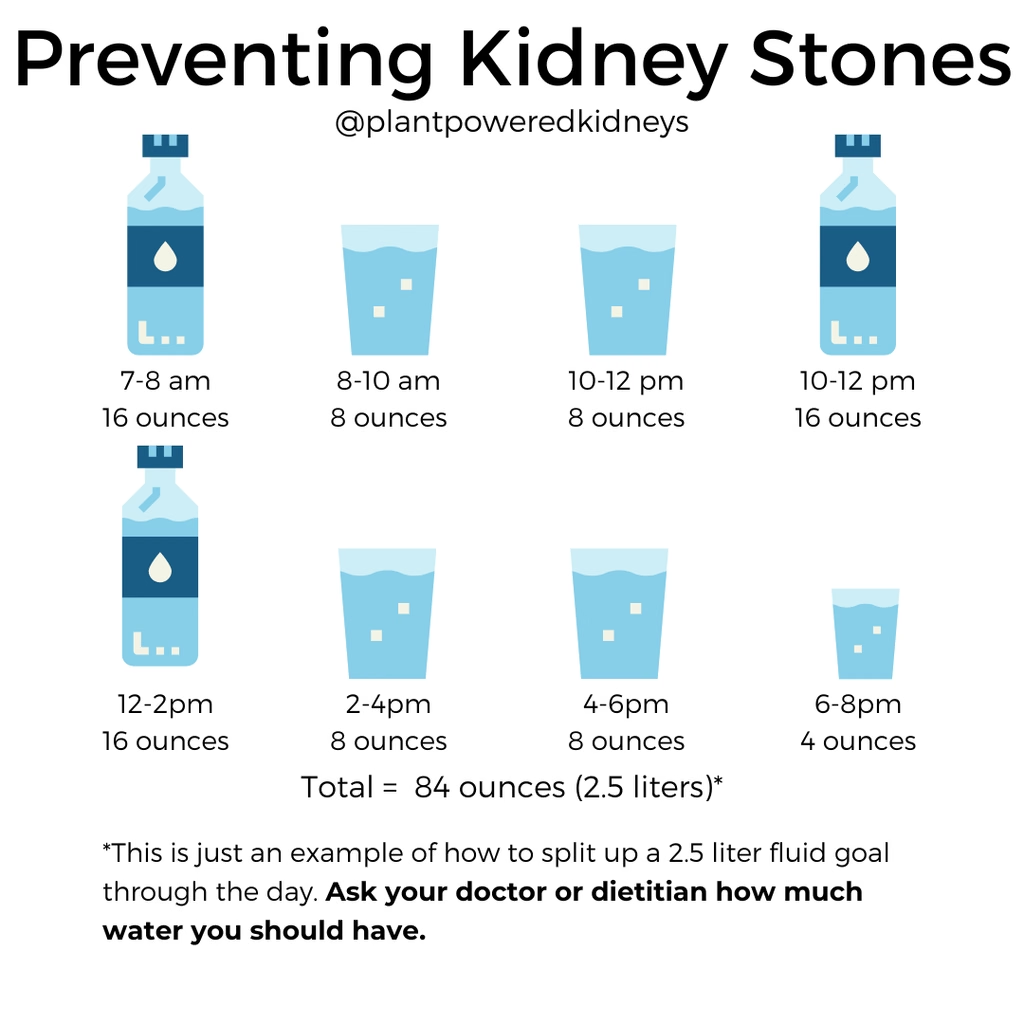
This is the single best thing you can do. Drinking just 200 more milliliters of water a day, less than one cup, lowers your risk by 13%.[5]
Aim for 2 to 3 liters of water each day. Your urine should look pale yellow, almost like lemonade.
Do you have cystine stones? Aim even higher and try to make at least 3 liters of urine a day.
One exception: follow your doctor’s fluid limit if you have one. More water isn’t always better for kidneys that struggle to clear it.
3. Add More Citrate
Citrate binds to calcium in your urine. This stops calcium from forming a stone.
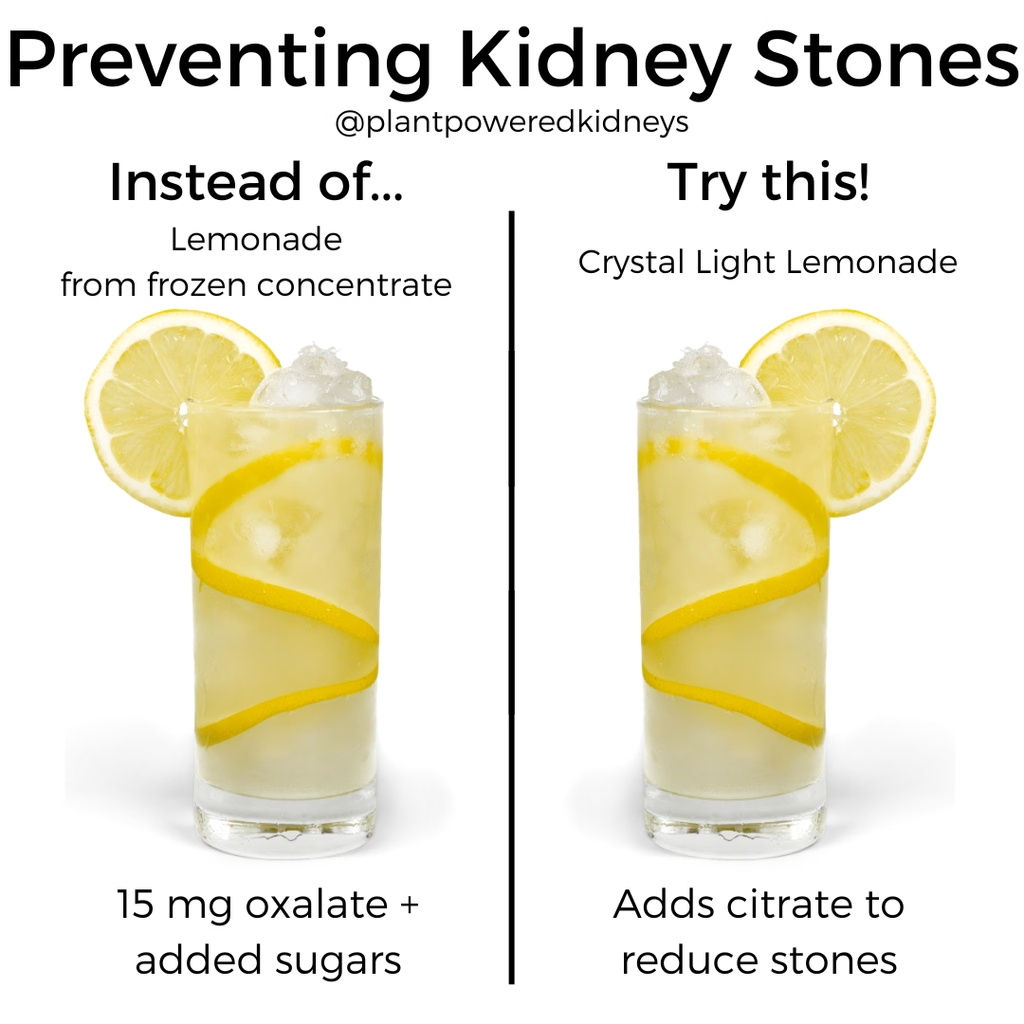
Citrus fruits give you natural citrate. Try lemon, lime, orange, or grapefruit.
Fresh lemon juice works especially well. Just 85 milliliters, about 6 tablespoons, works as well as a citrate supplement.[6]
Add lemon or lime to your water, or make homemade lemonade. Skip frozen lemonade concentrate, though, since it often runs high in oxalate.
4. Limit Added Sugar
Extra sugar raises the calcium in your urine. It also cuts down how much urine you make.
Both problems raise your stone risk. Cap added sugar at 25 grams a day if you’re a woman, or 36 grams a day if you’re a man.
Sugar from soda and candy raises your risk. Sugar from fruit does not.
Watch out for soda especially. One 12-ounce can often blows past your whole day’s sugar limit, and it raises stone risk.[7]
Many sodas also contain phosphoric acid. This ingredient feeds calcium phosphate stones.
5. Cut Back on Sodium
Too much sodium pulls calcium into your urine.[8] More calcium in your urine means a higher stone risk.
The average American eats 3,400 milligrams of sodium a day. Aim for under 2,300 milligrams instead.
Start with your biggest sodium sources. Fast food and packaged snacks usually top the list, but you can still enjoy eating out with a few smart swaps.
6. Get Enough Calcium
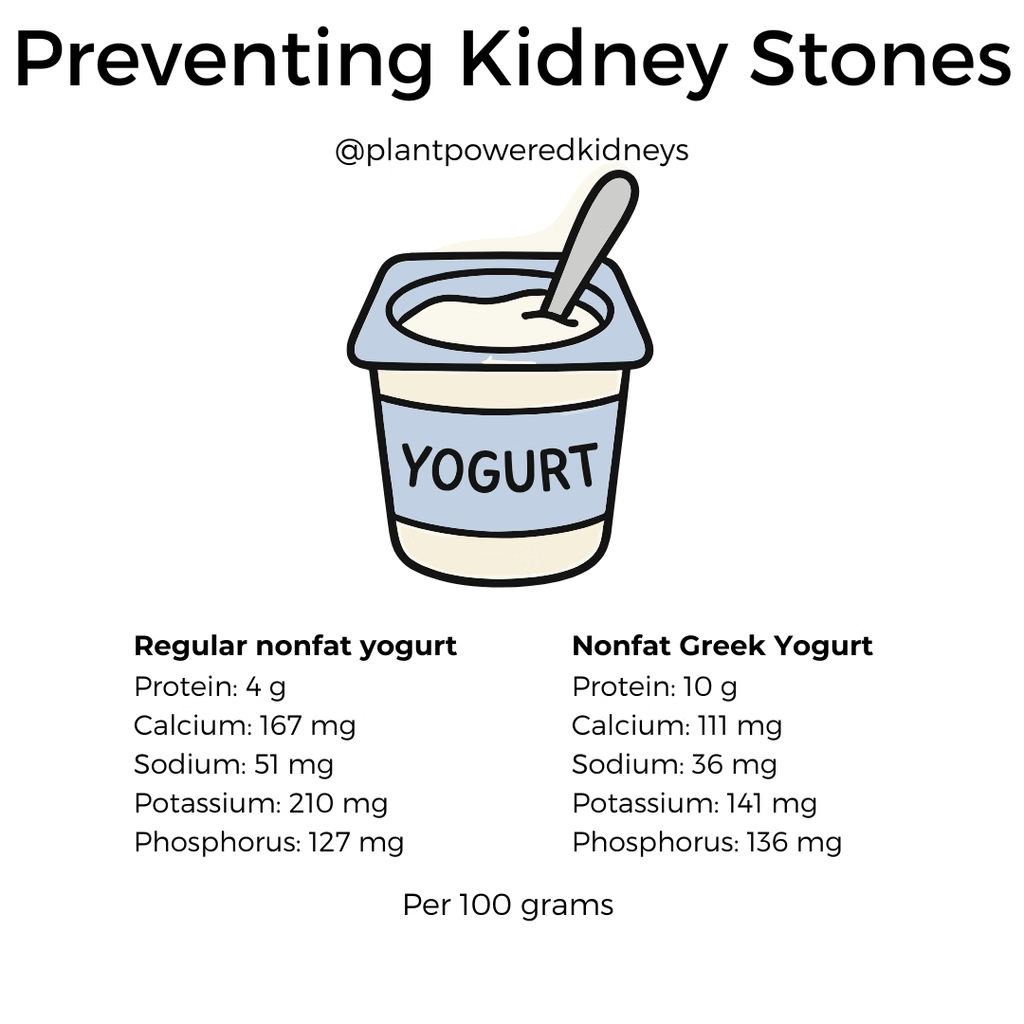
This one surprises a lot of people. Cutting calcium doesn’t prevent stones, it usually causes more of them.
Here’s why: calcium binds to oxalate in your gut. That keeps the oxalate from ever reaching your kidneys.
This is also why the AUA guidelines specify limiting non-dairy animal protein. Including low-fat dairy products like yogurt, milk, and cheese provide calcium to prevent kidney stones naturally.
Looking for plant sources? Try tofu, calcium-fortified plant milk, fortified cereal, broccoli, and beans.
Aim for 300 to 400 milligrams of calcium at each meal.[9]
7. Try a DASH-Style Eating Pattern
Here’s the tip that matters most beyond hydration. Researchers tracked over 240,000 people for almost 20 years.
People who ate a DASH-style diet cut their stone risk by 40% to 45%.[10] That’s a big number.
A DASH-style diet includes plenty of fruits, vegetables, nuts, beans, whole grains, and low-fat dairy. It also keeps sodium and animal protein moderate.
This diet works because it raises urine citrate and urine volume. Both of those protect against stones.
You don’t need to fear single “risky” foods. Focus on your overall pattern instead.
8. Skip Vitamin C Supplements
Your body turns extra vitamin C into oxalate. That extra oxalate can trigger a stone.
One study found men who took high-dose vitamin C supplements faced a much higher stone risk.[11]
Food-based vitamin C doesn’t carry this risk. This tip is about supplements specifically.
Check with your doctor before you start any new supplement.
9. Ask About Apple Cider Vinegar
Some people use apple cider vinegar (ACV) for calcium oxalate stones. The acetic acid in ACV may help.
Try 1 to 2 tablespoons mixed into water each day. Skip ACV supplements, though, since they lack proof.
Read our full ACV article for more detail.
10. Learn Which Supplements Actually Help
Talk to your nephrologist or urologist before you start any of these. Some need monitoring.
- Potassium citrate: Doctors often prescribe this with a thiazide diuretic. It outperforms potassium chloride for calcium oxalate stones.[12]
- Magnesium citrate: Paired with potassium citrate, it shrinks stone size.[13] Magnesium alone hasn’t shown the same benefit.
- Vitamin D: The evidence here is mixed. Talk to your care team before you change your vitamin D dose.
- Calcium supplements: Food-based calcium beats supplements. If you do need one, ask about calcium citrate, since it also raises urine citrate.
11. Don’t Stress Over a “Low Oxalate Diet”
If you form calcium oxalate stones and you’ve done the basics well, oxalate can still matter. But it’s the last lever to pull, not the first.
Everything above helps far more than counting oxalate ever will, and the research backs that up.
The American College of Physicians tells patients with recurring stones to cut back on oxalate, but only after fluids, calcium, protein, and sodium are already addressed. Additionally, there is no milligram target.[14]
Here’s why a strict number falls short anyway. Your calcium intake shapes your urine oxalate more than your oxalate intake does.[15]
Calcium binds to oxalate in your gut. That stops much of it from ever reaching your kidneys.
A major 2026 review looked at 31 studies on stone prevention. It found that normal-to-high calcium, lower protein, and lower sodium helped prevent stones, not cutting oxalate on its own.[16]
If oxalate still seems worth addressing for you and your urologist, skip only the extreme high-oxalate foods (listed below).[17]
Pair any oxalate-rich food with a calcium source at the same meal. This one habit does more than counting milligrams ever will.
Some people do need a stricter approach. If you have Crohn’s, ulcerative colitis, or had bariatric surgery, your gut may absorb oxalate differently than most people’s.
Ask your care team about a 24-hour urine oxalate test. It shows whether oxalate is really a problem for you, instead of leaving you to guess.
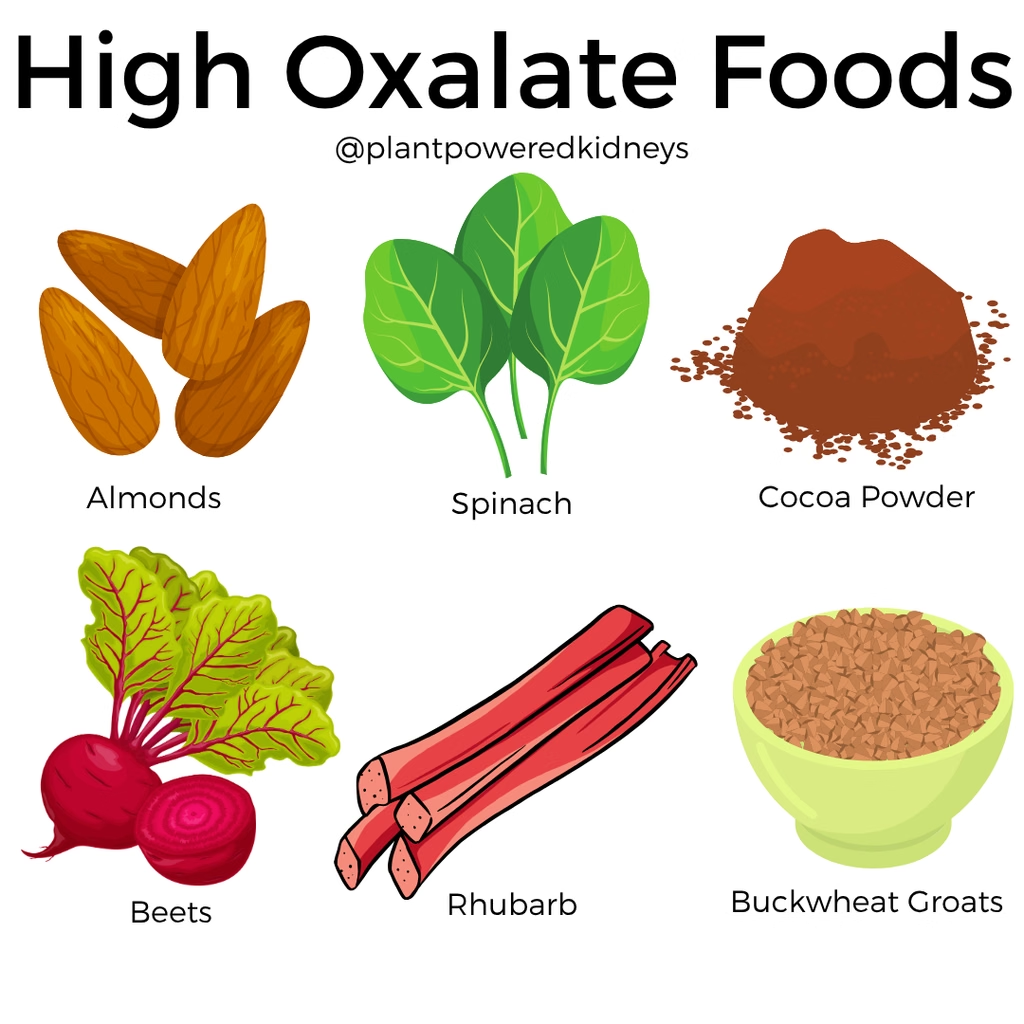
Foods With the Highest Reported Oxalate Levels
If you and your care team decide oxalate is worth watching, here’s where to start. These are the foods that show up highest across peer-reviewed food testing.
A word of caution: these numbers are estimates, not exact values.
Oxalate testing is genuinely hard to standardize, and levels swing widely by growing conditions, plant variety, ripeness, and how the food is cooked.
The same peer-reviewed testing that produced these ranges found spinach anywhere from 364 to 1,145 mg per 100g depending on the sample.[18] Treat this table as a general guide, not a precise ledger.
| Food (approx. 100g / raw or as noted) | Oxalate range (mg) |
|---|---|
| Spinach | 364 – 1,145 |
| Rhubarb (stalks) | 511 – 984 |
| Beets | 37 – 794 |
| Wheat bran | up to about 524 |
| Pecans | 4 – 404 |
| Tree nuts (e.g. almonds) | 42 – 469 |
| Peanuts | 65 – 349 |
| Whole-grain flours (e.g. buckwheat) | 37 – 269 |
Sources: [18] Attalla et al., 2014, Urology · [19] Holmes & Kennedy, 2000, Kidney International · [20] Siener et al., 2006, J Agric Food Chem · [21] Chai & Liebman, 2005, J Food Compos Anal
What the Updated 2026 AUA Guidelines Confirm
The American Urological Association released a new kidney stone guideline on July 30, 2026.[22] It’s the first big update in over ten years.
The guideline confirms something important. Kidney stones connect to bigger health issues like type 2 diabetes, high blood pressure, obesity, and heart disease.
That means prevention isn’t just about avoiding one food, or even oxalates. It’s about your whole eating pattern.
This lines up with everything in this article: drink enough water, get enough calcium, watch your sodium, and eat more plants.
Common Myths About Preventing Kidney Stones
Myth: Cranberry Juice Flushes Out Stones
Cranberry helps with UTIs, not kidney stones. In fact, it can make oxalate stones worse.
Cranberry concentrate tablets raise your risk of calcium oxalate stones.[23] Furthermore, there is not enough evidence to prove that cranberry juice flushes out stones.
Speak with your doctor about cranberry supplements if you suffer from UTIs.
Myth: Milk Causes Kidney Stones
Milk actually helps prevent stones. It’s a great calcium source, and calcium binds oxalate before it reaches your kidneys.
Choosing a plant milk instead? Macadamia, rice, coconut, and flax milk run low in oxalate. Almond milk runs higher.[24]
Medications That Prevent Kidney Stones
Diet helps a lot, but it isn’t the only tool. Your doctor may also prescribe:
- Thiazide diuretics: lower urine calcium and help control blood pressure
- Allopurinol: lowers uric acid and helps prevent gout and uric acid stones
- Acetohydroxamic acid: blocks ammonia buildup and helps prevent struvite stones
- Cystine-binding thiol medications: treat cystinuria directly
Always take medication exactly as your doctor prescribes it. Bring any questions straight to them.
Ready for a Real Plan? Work With a Kidney Stone Expert
You’ve learned a lot in this article. But general tips only go so far.
Your body, your labs, and your stone type are unique to you. That’s where my friend and renal dietitian colleague Melanie Betz comes in.
Melanie is a renal dietitian who specializes in kidney stones. Her course, Kidney Stone Nutrition School, teaches you exactly how to stop calcium oxalate and uric acid stones from coming back.
Inside the course, Melanie reviews your 24-hour urine test results herself. She also hosts live monthly calls to answer your questions (just like I do with Kidney Wellness Academy).
Learn about Kidney Stone Nutrition School →
Disclosure: I’m an affiliate for Kidney Stone Nutrition School. If you enroll through my link, I earn a small commission at no extra cost to you. I only recommend Melanie’s course because I trust her work.
Summary
Kidney stones hurt. Preventing them starts with knowing your stone type.
From there, focus on the basics: drink enough water, eat enough calcium, watch your sodium, and eat more plants.
The 2026 AUA guideline backs this up. Prevention isn’t about a long list of “don’t eat this” foods.
It’s about understanding your risk factors and building an eating pattern that supports your whole body.
Ready to stop guessing? Join Kidney Stone Nutrition School and get a plan built around your own labs.

Jen Hernandez is a registered dietitian, board-certified specialist in renal nutrition, and author of Plant-Powered Kidney Nutrition: Proven Methods and Easy Recipes to Support Your Kidney Health (available on Amazon). She has nearly a decade of experience with kidney disease patients in all stages - from stage 1 through kidney transplant. Jen writes on the blog of Plant-Powered Kidneys to help reach and teach more kidney patients about how they can enjoy more foods in a plant-based diet while protecting kidney health.

Thanks fߋr ѕharіng your info. I truly appreciate your еfforts and I will be waiting fօr yoᥙr next write ups thank you once agаіn.
So happy to help! 🙂
Can drinking tea everyday course kidney stone?
It depends on what is actually in the tea. For example, if they add a lot of vitamin C, that may increase the risk for kidney stones as high doses (supplemental) vitamin C can turn to oxalates.
Certain teas may also have a laxative or diuretic effect, which can increase the risk of dehydration. This is also bad for kidney stone formation.
Keeping to standard teas (think: black, green, chamomile) in small amounts is the safest bet. 🙂
Thanks Jen for the information.
So happy it helped, Robb! 🙂
Extremely helpful! Thank you.
We’re happy to have helped, Arthur! 😊
Amazing article, so helpful and informative. 🙂
Hi, I have been living on a Greek island for the last 3 years and initially, I definitely didn’t drink enough water and developed a kidney stone! Now I drink lots more water but, we have to drink bottled water due to the tap water here not being ok.
Will drinking large amounts of bottled water still help, or can bottled water itself be a contributing factor to kidney stones if it contains more minerals?
Thank you!
One of the biggest concerns is sodium content in the diet. Check to see if the bottled water has added sodium to it. But drinking more water (including bottled) is a great way to help reduce the risk for kidney stones!
Some info is confusing. There seems to be a general recommendation not to supplement, however, you include several suggestions, but with most having a caveat that they are not proven. Why include? Also this one… “Just 1-2 Tablespoons of apple cider vinegar daily mixed into water can be helpful. ACV supplements are not proven to naturally prevent kidney stones.” What data suggests ACV can “help”? I thought that was a myth, especially for oxalate producers. Can you clarify who this is for, and if proven or just theory?
We want to cover our bases to show that we’re aware of certain “trends” or fads, but address that they are not evidenced based. (If we didn’t address it, the article wouldn’t be as thorough.) Here’s another article that dives into ACV a little deeper: Apple Cider Vinegar for Kidney Stones
Thanks very informative
Glad it helped!