
Can you eat fast food if you have kidney disease? The answer is yes… with some careful choices. While most fast foods are high in sodium, phosphorus, and other things that can be harmful to your kidneys, there are still fast foods that are okay for kidney disease. This guide from a renal dietitian shares the better options at restaurants and drive-thrus. Whether you’re out running errands, on a road trip, or just need a quick bite, you’ll learn how to make fast food work for your kidney health, not against it.
*This article contains affiliate links in which we earn a small percentage of sales at no expense to you. We only ever provide affiliate links for products that we truly believe in and recommend for both ourselves and kidney warriors. Thank you for your support!
Table of Contents
Challenges with Fast Food and Kidney Disease
Before we dive into what to look for, it’s important to know what to avoid with fast foods that are okay for kidney disease.
Fast Foods Are Ultra-Processed Foods
A study published in 2022 found that people without kidney disease had a higher risk of significant kidney function decline when consuming ultra-processed foods.
Ultra-processed foods are considered foods that are high in saturated fat, sugar, salt, and additives, as well as being low in fiber and vitamins.
This is one of the reasons why they are not encouraged to be eaten frequently. They do not provide the nutrients we need, and give more of the nutrients we need less of.
Weight Gain and High Blood Pressure
Another study found that higher consumption of fast food can also cause weight gain, increased creatinine levels, and higher blood pressure.
This study asked a group of individuals to complete a food frequency questionnaire, otherwise known as a food journal.
The group that consumed the most reported eating about 119 – 151 grams of fast food per week.
For reference, a regular McDonald’s cheeseburger is 119 grams and an order of medium fries is 117 grams in weight.
However, limitations in this research included the quality of the fast food participants chose.
Sodium
It’s well known that dining out often means eating more sodium compared to homemade meals. Additionally, we generally underestimate how much sodium is in fast food.
A study in 2014 revealed that 90% of the adults surveyed underestimated sodium in a meal by an average of 1,000 milligrams.
That’s not too surprising, given that some fast food options have over 1,000 milligrams in just a sandwich.
Sodium is one of the biggest concerns when it comes to protecting kidney health. This is because one of the top causes of kidney disease is high blood pressure.
How Sodium in Fast Food is Getting Better
As the population is becoming more mindful of sodium, restaurants are becoming more transparent in their nutrition information.
Tools like nutrition calculators are becoming more accessible and encouraged. Nutrition information is available to the public.
Heart-healthy icons are added to certain menu options to reflect lower sodium options.
And in many cases, many restaurants are more than willing to skip the extra sprinkling of salt when requested.
Phosphorus
One of the most challenging parts of a renal diet and fast food is phosphorus. Finding low-phosphorus fast food is more than difficult- it’s nearly impossible.
A study in 2008 found that only 16% of the 804 entrees reviewed were free of phosphate additives.
Phosphate additives are considered harmful to kidney patients because they are highly absorbed. Therefore, they can easily increase blood levels if consumed.
Unfortunately, phosphorus is not required to be listed on the nutrition label. However, evidence suggests that it may be beneficial to the public for manufacturers to include phosphate information in their nutrition label.
If phosphorus levels are above 3.5 mg/dL, there is a higher risk of further damage to kidneys and an increased risk of death.
It’s also important to take a phosphorus binder if prescribed by your doctor.
How to Find Phosphorus Additives Online
Until nutrition labels start to require phosphate content, there are some tips we can share to help.
Starting with how to find phosphates by searching for them on a restaurant’s website.
The video clip below is directly from Kidney Wellness Academy.
If you are curious about finding phosphate additives in foods at a restaurant, here are the steps you will need to take:
- Look up the official restaurant website and search for nutrition ingredients. Ideally, they will have a PDF that you will be able to pull up. A good example is Subway listed under “Our Ingredients.”
- Once you have the PDF up, do a “find” search of the document by holding Control/CTRL and F (on PC) or Command and F (on Mac. Type phos in the search bar. This will highlight any words that contain the phrase phos, like phosphorus acid or tricalcium phosphate, two examples of phosphate additives.
- Make note of the foods you pass that do not have a “phos” highlighted within the nutrition information. You may need to scan those a little closer as some may say “refer to x product ingredients,” which may or may not have phosphorus listed.
- Once you comb the ingredients of the food items, you will have your own menu of no added phosphate foods.
- Warning: companies can change their ingredients at any time without notice. The list you create will not be set in stone.
Potassium
Unlike phosphorus, potassium may be a bit easier to look up.
The FDA required potassium content to be listed in 2016. However, this requirement has yet to be enforced and may still take time to become easily found on food and nutrition labels.
The FDA approved the use of potassium chloride to be used as a salt substitute at the end of 2020. This can be helpful for many as sodium is a concern.
However, potassium chloride may be an issue for people with hyperkalemia, or high potassium blood levels.
How to Find Potassium Additives in Fast Food
The same steps above for finding phosphate additives can also be used to find potassium additives. Just search for “potassium” instead of “phos.”
Potassium is not an issue for many with kidney disease. In fact, you may or may not need to limit your potassium.
Protein
For many with late stages of kidney disease, a low-protein diet can be helpful.
Fast food options can be packed with protein. Even meals we wouldn’t think of as high protein can have more than 15 – 20 grams of protein.
While that may not sound like a lot of protein, this can mean one fast food meal has about half of a daily protein goal for the entire day.
How Protein in Fast Food is Improving
More and more fast food chains and restaurants are offering plant-based options.
And while these aren’t always the best option (more on that later), there may be some that can help.
Plant proteins have a lower protein digestibility score compared to animal proteins. This means it can have less of a negative effect on kidneys, including better PRAL alkalinity and even better BUN lab results.
Potential Renal Acid Load
The potential renal acid load, or PRAL, of a fast food item can be more acidic.
This can happen when the phosphorus and protein content of a food is high, while the calcium, magnesium, and potassium content is low.
For example, a McDonald’s Cheeseburger has a PRAL score of 5.57 using our PRAL Calculator.
A positive PRAL value means the food has an acid load on the kidneys. A negative PRAL value means it reduces the acid load on the kidneys.
Learn more about PRAL – and try out our PRAL calculator – on our blog article all about Potential Renal Acid Load.
How Often is it Okay to Eat Fast Food with Kidney Disease?
Besides limiting the quantity, the quality of the fast food choices can determine if fast food is okay for someone with kidney disease.
Enjoying fast food once per week while choosing healthier options, it’s still possible to include fast foods and protect kidney function.
By selecting a smaller, or even “junior” meal, you are better at limiting the problematic items listed above like phosphorus and sodium.
Additionally, choosing to eat out once per week but indulging in an entire pizza is not considered “one meal.”
Tracking Fast Food in a Food Journal
Another recommendation I highly suggest is tracking your food and nutrition. We recommend Cronometer*.
By tracking your foods and drinks, you will be able to look at trends. This is especially important leading up to a lab draw. Or, that inevitable question from your doctor… “What have you been eating?”
Cronometer includes a very lengthy database to include restaurant and fast food chains. You can even plan ahead by searching their database and scheduling a meal to see how it may impact the rest of your food choices for the day.

Click here to check out Cronometer and try their free plan.*
Kidney-Friendly Fast Food Examples and Ideas
Examples are always helpful. In this next section, we’ll highlight some popular fast food restaurants with specific examples of what can fit.
Burgers & Chicken Sandwiches
When it comes to fast foods that are okay for kidney disease, it’s pretty obvious that we talk about one of the most common choices – hamburgers.
However, we need to make one thing clear.
Beef burgers still include potassium.
Yes, even meat has potassium. A burger will contain approximately 200 milligrams of potassium.
Stick to a 4-ounce meat option.
Whether it be beef or chicken, this is about the size of a deck of cards. Limiting this amount can keep kidneys safe. Even on dialysis, you don’t need more than that.
Condiments on the side.
Instead of having them decide how much ketchup, mustard, mayo, and relish to top on, skip it all. Ask for a packet of each ketchup and mustard, mayo if they have it, and add it yourself.
The difference will shock you, but that goes to show the heavy-handed dollops they add are likely high in sodium and fat.
Load up with veggies.
And a slice or two of onion, even a slice of tomato will work.
This is where we say you should stack up. Ask for extra lettuce, onions, even pickles if you like.
Skip the cheese.
Although if you did your research on phosphates and potassium additives, you’ll probably already know this. By the way, a slice of cheese can add over 200 milligrams of sodium.
McDonald’s®
Stick with McDonald’s® classic hamburger. Add extra lettuce and skip the pickles if you need to avoid potassium additives or extra salt. This change alone will drop the sodium from 510 milligrams to 470 milligrams.
If avoiding red meat, try the filet-o-fish. The fish will give you 480 milligrams of sodium (without the cheese and with the tartar sauce) and no phosphate/potassium additives.
Sorry, but the chicken options are not kidney friendly here. The chicken patty used in their sandwiches contains phosphate additives.
Apple slices are a low-potassium fruit that will add sweetness and crunch to your meal. Get two packs if you like.
A small order of fries can fit, even with the potassium. It has just under 500 milligrams of potassium. It will also add about 200 milligrams of salt to your meal, which is only about 10% of a sodium goal for a day.
Iced Tea (unsweetened), lemonade, Sprite, apple juice, or black coffee are your best options here. No added phosphates or potassium.
Ask for extra ice and stick to a small size if you need to limit your fluids.
Plant-Based Burger Option
McDonald’s recently released their first plant-based sandwich, the McPlantTM. This sandwich uses the Beyond Meat meat substitution and is currently available in select stores in Texas and California.
Compared to the Quarter Pounder with Cheese, it’s essentially the same nutrition profile.
Both clock in around 500 calories. Both are over 1,000 milligrams in sodium. Both are also just above 400 milligrams of potassium as well.
The plant-based option has 8 grams of saturated fat, whereas the beef option has 12 grams of saturated fat.
Burger King®
Many of our clients have asked if vegan meat-substitute options like the Impossible Burger can fit into a renal diet. And many have tried.
Burger King ® had previously used MorningStar Garden Patty veggie burgers as their vegan/vegetarian option.
Even though this is considered as a “plant-based” alternative, it is not something to include often.
The Impossible Whopper®
The Impossible Whopper® has 630 calories compared to the original Whopper® with 660 calories.
Both are incredibly high in sodium, with the original Whopper at 1,170 milligrams. And the Impossible? It has 1,350 milligrams of sodium.

If you have later stages of CKD and need to limit your protein intake, the Impossible Whopper won’t do you any good. It has 29 grams of protein compared to the regular Whopper’s 32 grams.
A Burger King Order for Kidney Patients
If your only option is Burger King®, we would suggest sticking with the Whopper Jr. It has 560 milligrams of sodium and 15 grams of protein. Ask for extra veggies like lettuce, onion, and tomato.
Add a side of applesauce for a little bit of fiber (just one gram, but it counts) and no added sodium.
If fries are a must, their value size is 230 calories and only 130 milligrams of sodium. Potassium is not included in the nutrition information, but just know that it may be about 500 milligrams of potassium.
Chick-Fil-A®
One of, if not the most popular fast food chains is Chick-Fil-A®. There are a few better options
Sandwiches
Unfortunately, their sandwiches are very high in sodium and protein. The classic Chicken Sandwich has 420 calories with 1,460 milligrams of sodium and 29 grams of protein.
The Spicy Deluxe has nearly an entire day’s worth of sodium in one sandwich. Sorry to be the bearer of bad news, but this one isn’t a fast food option for kidney patients.
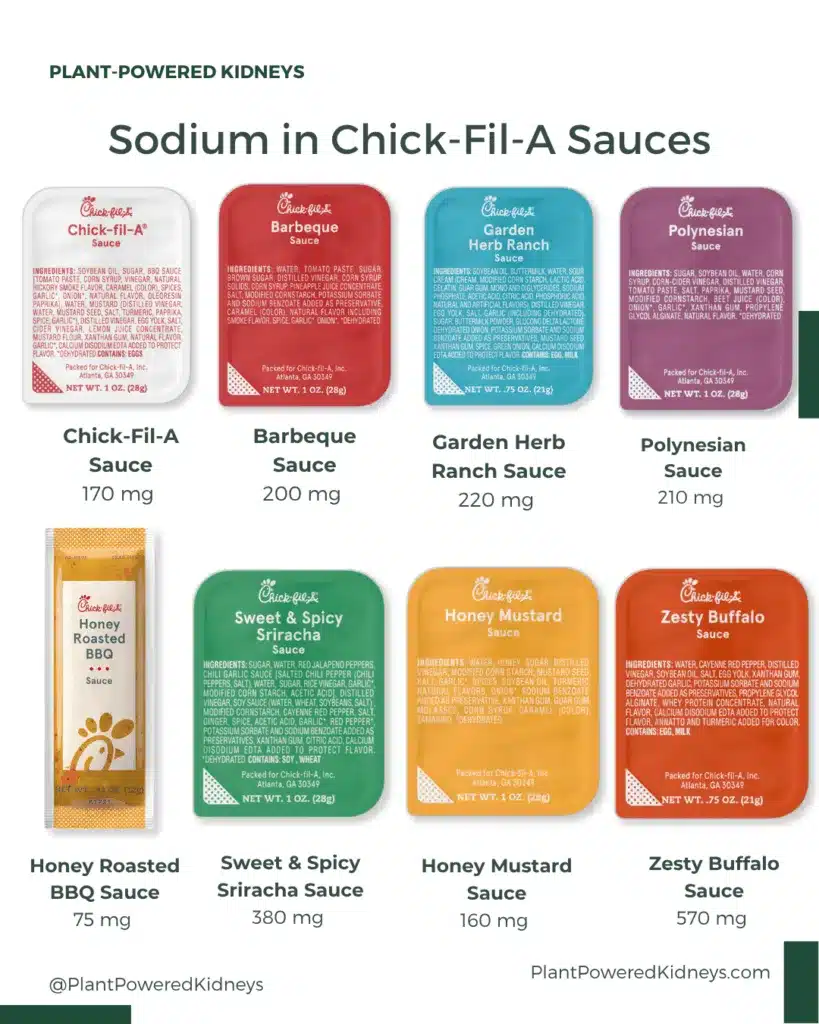
Salad
A better option will be the Market Salad with Grilled Filet. This salad has 560 milligrams of sodium, 5 grams of fiber, and 28 grams of protein.
Add the Fat-Free Honey Mustard Dressing for an additional 330 milligrams of sodium, which is their lowest sodium dressing option.
Keep in mind this tallies to 890 milligrams of sodium. So be careful with salt for the rest of your day.
Are there plant-based sandwiches at Chick-Fil-A®?
Chick-Fil-A® announced in early 2023 that a cauliflower-based sandwich would be tested out in some stores.
However, they stopped serving this sandwich in mid-2023.
Vegan or fully plant-based options at Chick-Fil-A® include their sides of Kale Crunch Salad, waffle fries, and fruit cup.
In-N-Out®
The last burger spot we’ll cover in this list of fast foods that are okay for kidney disease is the classic In-N-Out®.
This menu is easy to go through as it’s short and sweet.
Go for the protein-style hamburger here, which has 200 calories, 12 grams of protein and 390 milligrams of sodium (compared to 660 milligrams with the bun).
An order of french fries will be 360 calories with 150 milligrams of sodium and 6 grams of protein. Honestly, this isn’t bad for fries, especially since it also includes 6 grams of fiber.
And again, their nutrition information does not include potassium, which is still going to be a part of potatoes whether it’s listed or not.
For a drink, stick to 7-Up®, Barq’s Root Beer® (phosphate-free), lemonade or iced tea. Of course, black coffee works, too.
In-N-Out® currently has no vegan or plant-based sandwich options.
Chinese Food
Some of the great things about Chinese food is that they often include many vegetables and plant proteins. Additionally, the staple of rice is very kidney-friendly and can easily be included into a renal diet.
However, sodium is a top concern when it comes to Chinese food. But by focusing on a plant-heavy dish and requesting steamed varieties, you will significantly lower the sodium (and fat) content of your dish.
Serving sizes can often be family-size, even when marketed as an individual plate. If concerned with the amount, request a side plate and serve yourself a meal on that.
Panda Express®
A lot of people ask about kidney friendly Chinese food, which of course brings to mind one of the most common Chinese restaurant chains, Panda Express.
Eggplant Tofu would be seen as a good option at first as it includes a plant protein. However, there are added phosphates. It also is quite high in sodium at 520 milligrams per serving.
Even their Super Greens have added phosphates. This wouldn’t be something I’d include very frequently.
However, it’s my opinion that the nutritional value and benefits of the veggies can outweigh the small amount of phosphorus here.
Their teriyaki grilled chicken, however, does not appear to have added phosphates but comes with 530 milligrams sodium alone.
Stick to 3 ounces, which is half of the amount they include, for the best portion for kidney health.
By limiting the amount to 3 ounces, you’ll have 235 milligrams of sodium and about 17 grams of protein.


This Cronometer* screenshot includes the grilled chicken option instead of the eggplant tofu.
All other entrees at Panda Express unfortunately have phosphate and/or potassium additives.
I would recommend choosing a bowl of half rice and greens for a lesser amount of phosphate additives. A chicken egg roll to go along with it can be acceptable.
This meal provides about 620 milligrams of sodium and 12 grams of protein and 7 grams of fiber (and 64 net grams of carbohydrates for those of you following a renal diabetic diet).
Cream cheese rangoons are phosphate/potassium additive free, as is the hot and sour soup (mind your fluids and keep to the smaller serving).
Coffee Shops
When choosing a fancy coffee order, keeping to the small (“tall”) cup size is a great way to enjoy it while not overdoing it.
Of course, black coffee is an easy option (and yes, you can have coffee even if you have kidney disease).
Choose sugar-free syrups if you need a sweetened drink.
Not a fan of sugar-free? Try half sugar-free, half regular.
A 20-ounce sweetened black coffee will set a woman over her daily allowance of added sugars. Also, skip the whipped cream for even less sugar and saturated fat.
Finding the phosphate additives here is much trickier as they do not feature a webpage or PDF that includes all ingredients.
To identify if a menu item has additives, you need to individually select that option and then review the ingredients. You can still do “control + F” search (command + F on a Mac/Apple computer) on that web page to make it a bit quicker.
Starbucks®
Stick to the cow’s milk or almond milk. Oat and coconut milk options have phosphate additives, as shown in the image above. Soy is difficult to find and may vary store-to-store.
The cafe mocha has no potassium or phosphate additives (although chocolate has organic phosphorus).
Vanilla and classic syrups have potassium additives but no phosphate, so they could be a good choice for those without potassium concerns.
Breakfast
If you need breakfast to go along with it, the Spinach, Feta, and Egg White Wrap is a decent choice with no additives. Beware the sodium content, however, as it clocks in at 830 milligrams.
The Sprouted Grain Vegan Bagel will give you 12 grams of protein and 7 grams of fiber along with 490 milligrams of sodium for 330 calories. Having some cream cheese, which is lower in phosphorus and potassium is acceptable.
In fact, the majority of their hot bakery items do not have phosphates included, with the exception of their smoked bacon.
Lunch
Need lunch? The Tomato and Mozzarella sandwich should do, with 580 milligrams sodium and 15 grams of protein (although that may be too much protein if you’re on a severe protein restriction).
The Prosnax Green Apples, Egg, Mild Cheddar Cheese, and Cashews Snack Box may be a better option at 250 milligrams sodium and 13 grams protein for 320 calories.
Bakery sweets are not recommended due to the low nutrition value and high sugar, saturated fat, and oftentimes sodium content.
Sandwich Shops
When it comes to choosing a kidney-friendly sandwich, choose the least-processed meats (if any).
Sticking to a veggie sandwich is ideal in this situation. This helps to sodium low, and fresh veggies should not have phosphate and/or potassium additives.
Adding creaminess with avocado (if your potassium allows for it) or regular mayo. Vinegar and oil are good options to add flavor without sodium and healthy fats.
Wraps are generally not recommended as the tortillas are high in sodium and are most guaranteed to include phosphate additives.
Subway®
A 6-inch Veggie Delite on 9-grain wheat with some avocado and mayo will surely be filling. It’s also one of the cheaper menu items.
Don’t like wheat and need a little animal meat? Try the Turkey Breast (it has no added phosphates) on the artisan flatbread. It will bump up to 720 milligrams of sodium and 18 grams of protein, but still includes 5 grams of fiber.
I wouldn’t bother with the sliders considering they’re not filling enough for a meal but provide the sodium amount for one (about 500 milligrams for only 200 calories and 1 gram of fiber).
For the best side, grab the applesauce pack for an easy and portable side that is low in potassium. Add a small drink if you need it – brewed iced tea or bottled water is best here.
Panera ®
As mentioned above, sodium is one of the toughest challenges when it comes to finding fast foods that are okay for kidney disease.
Fortunately, Panera® has a sodium-conscious menu available for customers.
The Garden Avo & Egg White Sandwich has 720 milligrams of sodium and 19 grams of protein. While this may seem high in sodium, it is one of their lower-sodium options.
For example, the Green Goddess Caprese Melt has 2,230 milligrams of sodium.
Alternatively, you can choose the Steel Cut Oatmeal with Strawberries, Pecans & Cinnamon Crunch Topping for 170 milligrams of sodium and 6 grams of fiber. It also provides 7 grams of plant protein.
Arby’s®
Many have asked for a renal diet option at Arby’s®. And similar to some of the other fast food restaurants mentioned above, there are not a lot of options this dietitian can get behind.
All of the beet and chicken sandwiches are around 1,000 milligrams of sodium or more. Even the Market Fresh® options are a days’ worth of sodium for some kidney patients.
Their deli meats also have added phosphates, which are hard for kidney patients to control.
Additionally, their popular curly and crinkle-cut fries contain added phosphates.
This, besides the sodium content of 570 milligrams for a small (1,250 for a large) order, makes it not a kidney-friendly place.
Kidney-Friendly Tacos & Mexican Food
Mexican restaurants will often have vegetarian and vegan options easily available. Two of the biggest veggies included in Mexican-style food are peppers and onions, which are lower in potassium.
Tacos can absolutely be a part of fast foods that are okay for kidney disease – it just takes some variation in the typical orders to make them more kidney friendly.
When it comes to tacos, choose crunchy and corn tortillas over soft shell flour tortillas.
Corn tortillas are significantly lower in sodium (sometimes even with no added sodium) compared to flour tortillas that can be hundreds of milligrams of sodium.
Finally, go easy on the salsa. It adds up quickly with both sodium and potassium.
Taco Bell ®
Not only do I actively participate in #TacoTuesday, but even I will swing through for a Taco Bell lunch from time to time. And I have a bit of a bias with Taco Bell because I love their nutrition calculator!
After doing the research between these different restaurants, Taco Bell’s nutrition information actually allows you to sort lowest to highest sodium.
Choose the crunchy taco shells over soft tortillas. This is because of the sodium content (310 milligrams compared to 500 milligrams per taco). They also have added phosphates.

You can almost have two crunchy tacos for the amount of sodium you get from one soft taco.
Tacos
If you can’t stay away from soft taco, try the Fresco Shredded Chicken soft taco. It has 430 milligrams of sodium and no added phosphates in the chicken.
The Black Bean Chalupa Supreme® has 460 milligrams of sodium, but also 10 grams of plant protein and 6 grams of fiber. Remove the cheese and sour cream to drop it to 380 milligrams sodium.
The Spicy Potato Soft Taco® has 470 milligrams of sodium, with 2 grams of fiber and 5 grams of protein. Skip the cheese but keep the Creamy Jalapeno sauce for 420 milligrams of sodium.
And while potatoes do have potassium, this taco only has 270 milligrams of potassium.
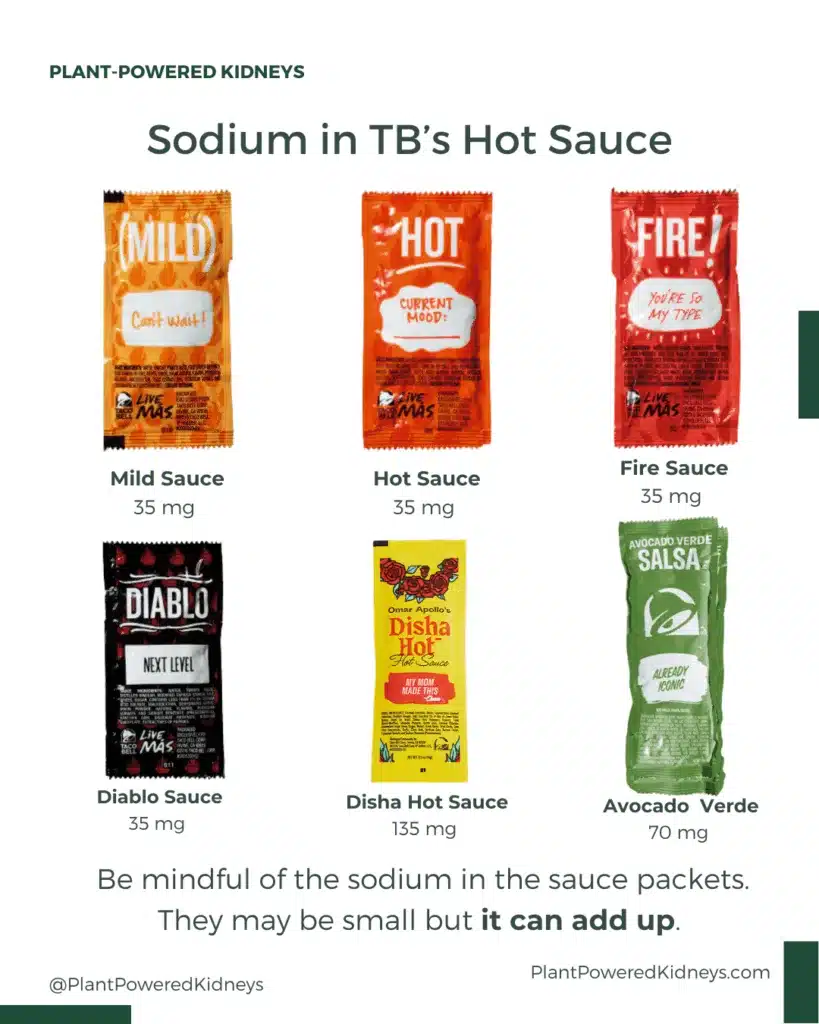
If you like their hot sauce packets, stick to either mild or Diablo. They provide 30 and 35 milligrams of sodium, respectively.
Bowl
If you’re looking for more of a hearty meal, try a bowl.
Get the Veggie Power Bowl. However, skip the cheese, sour cream and avocado ranch sauce to keep the sodium better controlled at 690 milligrams.
But for that you get 8 grams of protein and 10 grams of fiber, which will help fill you up.
Chipotle®
Another popular grab-and-go restaurant is Chipotle®. This one is great in that they offer plenty of veggies, whole grains, and plant proteins including tofu and beans.
They also have a fun nutrition calculator you can use to tally up your macronutrient totals for the meal. This can be helpful for those that need to limit protein intake.
Tacos
Choose the three Crispy Black Bean Tacos. Add the fajita veggies, tomatillo-green chili salsa (their lowest sodium salsa), lettuce, and cheese.
This order will give you 19 grams of plant protein and 13 grams of fiber.
If you don’t like black beans, their pinto beans have a very similar nutrition profile.
However, it will tally up to about 700 milligrams of sodium. This is about a third of a day’s sodium amount, which makes it okay for a whole meal.
Salad
If you choose a salad, skip the Chipotle-Honey Vinaigrette. It has 850 milligrams of sodium in the 2-oz serving.
Instead, opt for the Tomatillo-Green Chili Salsa, which has just 260 milligrams of sodium.
Burrito Bowl
Many choose the Burrito Bowl at Chipotle® because it includes so much variety.
If this is your preference, choose the brown rice over the white rice. It has about half the sodium of white rice (190 milligrams compared to 350 milligrams).
The fajita veggies are also low in sodium at 150 milligrams.
The guacamole as a topping or side has 370 milligrams of sodium, which is quite high. However, it also provides 6 grams of fiber and of course plenty of potassium.
The potassium content is not listed in their nutrition information, so we cannot provide specific numbers for that.
Pizza
Pizza is typically a no-no when it comes to the renal diet. High in sodium (from the crust, cheese, and toppings like processed meats), high in potassium (from the cheese, tomato sauce, and toppings), and low in nutritional value of fiber.
But you can make changes to help change that.
Choose a whole wheat crust when available. Thin crust can be another option but may be just as high in sodium as the regular crust, plus more saturated fats. Each company will be a little different.
Many pizza joints like Pieology are now adding cauliflower crusts to their menu. This can be a great way to get more vegetables. However, cauliflower crusts are often higher in sodium.
Papa John’s®
Go with Papa John’s gluten-free crust for the lowest sodium at 100 milligrams. Choose Alfredo sauce over the traditional tomato-based sauces to keep potassium in check.
Good news with PJ’s ingredients is that they don’t have added phosphate or potassium preservatives in their crusts.
The bacon, philly steak and chicken meat options have added phosphates. Other meat options do not have additives but will definitely add up in sodium. I would still recommend avoiding all meat options when it comes to pizza.
A slice of the gluten-free garden fresh pizza will give you only 300 milligrams per slice.
The plain breadsticks or cheese sticks are phosphate-additive free but definitely won’t contribute much nutritional benefits and, again, raise the sodium of your meal.
Each breadstick will add about 250 to 300 milligrams of sodium. That’s about the same amount of sodium in a slice of pizza.
Get more ideas for pizza options in this blog article.
Summary
We need to all have a better game plan when it comes to eating out and choosing fast food. It’s unrealistic to say we will never go out to eat, so let’s make a plan and have some quick meals that we can find are best for us.
Fast food options will typically be high in sodium. They often included added phosphates. However, this may not always be easy to determine. Be sure to follow your doctor’s prescription if you are on a phosphate binder.
Taking the time to find some fast foods that are okay for kidney disease is not a bad thing. In fact, planning ahead with meals out means you can still support your kidney health goals.
To help you make that game plan for yourself, I have created a CKD Fast Food Guide to guide you and keep you on track. List your preferred restaurants, look up their information and keep track of a few menu options you know are best for you and your kidney health goals.
I highly recommend you do the work and check your restaurants. Then review the information you collect with your renal dietitian and nephrologist to be sure that it is acceptable for your kidney disease, your labs, your health.

Jen Hernandez is a registered dietitian, board-certified specialist in renal nutrition, and author of Plant-Powered Kidney Nutrition: Proven Methods and Easy Recipes to Support Your Kidney Health (available on Amazon). She has nearly a decade of experience with kidney disease patients in all stages - from stage 1 through kidney transplant. Jen writes on the blog of Plant-Powered Kidneys to help reach and teach more kidney patients about how they can enjoy more foods in a plant-based diet while protecting kidney health.

Great information. Thanks for sharing.
Happy you enjoyed it! 🙂
Hi,
Newly diagnosed with kidney disease and have been doing alot of research on what one should eat or avoid and many of the websites that talk about foods that are allowed mention white breads and flour tortillas are recommended yet other sites will say you should have whole wheat or choose corn tortillas over flour tortillas. There seems to be an awful lot of contradictory information and I don’t know what to believe. I read where you recommend corn tortillas over flour so again I’m finding that this is getting more and more confusing. Help!
Hi MB!
You’re so right – the renal diet and all the recommendations can be quite confusing and overwhelming. The challenging thing about kidney disease is that there are so many causes and so many unique situations that the recommendations will tend to be all over the place. Old recommendations used to promote white breads and flours, but no more! We now know that whole grains have more nutrients that are very helpful not only for CKD, but overall health. The phosphorus is not well absorbed, which is why it can be a part of a low phosphorus diet. Corn tortillas are a great option as they don’t usually have phosphate additives and are much lower in sodium than flour tortillas.
Finally, if you’re still unsure, working privately with a dietitian can be a great way to cut through all the noise and get personalized answers based on your own health needs. We have a dietitian that just started taking clients here. You can meet our team of dietitians here to learn more. 🙂
How true are the labels on the ingredients of the food that we buy.
For the most part, they’re pretty accurate. But some companies can make mistakes, so it’s important to think a little bit about it. I’ve seen dried mango with “0 milligrams” of potassium – that has to be false.
Great information I’ve just been on dialysis for three weeks and being afraid to eat the norm foods really scare me. So thank you for this great information
I’m happy this helps, Terry! There’s a lot to deal with when starting dialysis. I know it can be overwhelming – I’ve worked with hundreds of patients on dialysis. But it gets easier, I promise! Don’t forget to check out our article about Protein Supplements for dialysis! – Jen 🙂
Great guide Jen. It’s good to know that there are some fast foods that are at least acceptable for CKD patients. This info will help me make better choices about what I order, and more importantly, how often. I’m also going to take advantage of the SMART diet tips and fine tune my plan. Thanks as always.
So glad it’s helped, Willie! Love that you’re using the SMART goals to set a plan in place, as well!
Jen, how does intermittent fasting Help CKD. Is there a way to include it in my diet plan? Thanks
Richard
Hi Richard! There is limited evidence as to whether intermittent fasting has a direct impact on kidney protection. In any case, it’s best to discuss something like this with your healthcare team first as not everyone will benefit from IF. 🙂
hi thanks for the imformation my auntie have kidney promblems and that really helped her so thank you so so much
You’re most welcome, Andreius! 🙂
Having just left the hospital after threatening to leave the coming night at 3am “bare naked” if I were not released immediately following my 2 week forced stay, I somehow went to stage 3, 45# kidney function..
All due to a mysterious, strange and painful hip joint infection that caused blood MRSA dropping kidney function to 17.
This article is very helpful since my iidney doctor has not sent me to any nutrition classes.
Thank you
Lewis
We’re glad that you have found this information helpful! 🙂
Great information. Glad to know that the meds is fast-food that we can eat. It’s confusing trying to figure out what and what not to eat. One site says this and one site says another. Thank you for making it easier for us.
So happy to help, Pamela. It’s important to find good options out there, because sometimes we NEED to eat when we’re out. That’s just real life, right?
I make my own bread and I have been using Gold Medal flour because I read that was the best flour choice for kidney disease, but should I be using Whole Wheat flour instead.
Either will fit! Whole wheat can be a great option as it is a little higher in fiber, but you can also include fiber with other foods/components of a meal using the bread you make. 🙂
Thank you for clarifying food choices, very helpful.
So glad to hear that! 💚